Are you working on addition strategies in your first-grade classroom or homeschool? The make ten strategy is a great way to increase student fluency and helping students learn to compose numbers. Today, I am sharing some make ten games. These activities are perfect for your small groups and interventions. Once the games have been introduced and practiced, they are easy to transfer to an independent learning center.

Shake it up is a super fun game to practice making ten. Students put ten 2-sided counters into a small cup, shake it up, and dump them out. They record the counters on a ten frame and write a matching addition sentence.
Make 10 Game: Spin and Build
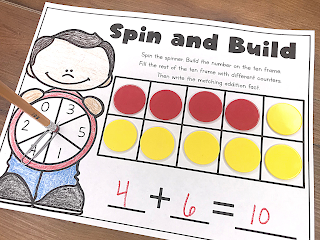
Kids love playing spinner games! In this make ten game, students spin a number and build the number with red counters. Then, they add yellow counters to equal ten. Last, they record the making ten fact on their sheet. Laminate the mat or slide it into a dry-erase pocket so kids can spin and build combinations to 10 over and over.
Make Ten Game: Fill The Bus

Start with ten frame mats that already have one number represented. Students add cubes to the bus to fill the rest of the ten frame. Then use magnetic numbers or number tiles to show the two numbers that make ten.
Make Ten Game: Addition Staircase

Make Ten Staircase is a great activity for showing students ALL the combinations of ten in a systematic way. Students start with 20 cubes- 10 of two different colors. They begin with all cubes of one color, then slowly begin changing one cube at a time.
They record the cubes as they go, so they can see the visual pattern in the cubes and numbers. This is a really great activity if you have enough cubes to physically layout the number staircase.
Make 10 Card Game: Go Fish!
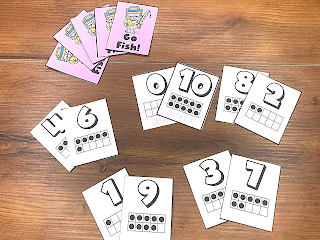
Card games are another great way to practice ways to make ten. You can play games like Go Fish and Memory where students find the number combinations to ten. A deck of playing cards works great, just remove the face cards and the ace makes 1.
Make Ten Game: Dominoes to Ten

Use a set of dominoes to practice! Instead of matching identical numbers, students match numbers that make ten. You will need dominoes that go up to 9 to play this game. This is a great game to play in a group, with a partner, or even on their own. Add in a simple recording sheet to increase the accountability.
Roll and Make Ten
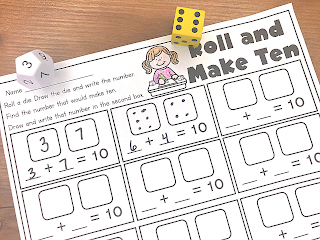
Somehow, dice make everything more fun! If possible, use a die with ten sides so that students can build all the different number combinations to ten. For students who need more support, the dice with dots are a great place to start. For students working on fluency, dice with numerals are great!
Roll and Stack to Make Ten

In this activity, students roll a dice. They find the number on the mat. Then, they stack the number of cubes it takes to make ten. So, if they roll a 4, they find the four on the mat and stack 6 cubes to make ten. Kids can play with a partner. Give each player a different color of cubes. They take turns rolling and stacking. The winner is the player who can get 5 stacks in a row.
Find a Match Game

Once students have a concrete understanding of ways to make ten, then it is time to build their fluency! In this partner game, students find two numbers that make 10. They color both numbers. Then, the next partner goes. The winner is the person who can color 5 numbers in a row. Students will learn to also use some strategy to “block” their partner. Students can play this game over and over!
You can grab a free set of this game below!
Make Ten Interactive Notebook Activity

Your kids will love making this project to add to an interactive math notebook, or you can even use it as a craft! Students cut and glue all of the flaps to make each set of numbers equal ten.
.png "Make Ten Hands On Math")
Need more hands-on addition ideas for first grade? Check out this post about teaching the Commutative Property of Addition.