Are you looking for fun and effective ways to help your learners understand the commutative property of addition? Teaching this concept doesn’t have to be dry or filled with drills. With a few commutative property of addition games, your students will develop a deeper understanding of the concept, all while engaging in fun hands-on activities!

What Is the Commutative Property of Addition?
The commutative property of addition simply means that you can add numbers in any order, and the sum will remain the same.
For example:
3 + 5 = 8 and 5 + 3 = 8
In first grade, I like to call these turn-around or flip-flop facts. Giving this abstract property a playful name makes it more concrete for students. Be sure to also introduce the correct math vocabulary but pairing it with a kid-friendly nickname helps the concept click.
Understanding this property helps students:
- Build fact fluency faster (because 4 + 6 and 6 + 4 don’t both have to be memorized!)
- Strengthen number sense
- Lay the groundwork for algebraic thinking – a+b=b+a
Why Teach It with Games?
Games make learning memorable, increase student motivation, and provide opportunity for social development. When students play, they’re learning without even realizing it — and they’re eager to keep practicing!
Commutative property of addition games are:
- Hands-on and engaging
- Perfect for small-group or independent math centers (providing meaningful practice)
- Easy to differentiate
- Quick to prep (especially if you use manipulatives you already have!)
These activities give students lots of practice seeing that the order of the addends doesn’t change the sum, all in a low-stress, high-fun environment.
5 Hands-On Commutative Property of Addition Games
1. Link It! Chain Link Addition
Give students two colors of plastic math links. If you’re practicing 2 + 6, have them connect two red links and six blue links. Then ask them to turn around the links to show 6 + 2.
Seeing that it is the exact same chain, really helps students develop a deeper understanding of the concept— the total doesn’t change even though the order did!

This visual commutative property of addition game is a perfect concrete introduction to the concept. Students grab an addition sentence. They build the commutative addition fact with links. Then, they turn it around and find the matching addition fact to complete the match. Once students have been introduced to this game, it makes a great independent activity to use during centers, or morning bins.
2. Dice Games for Practicing the Commutative Property
Grab two dice and let the rolling begin! Students roll both dice and record their first equation (e.g., 4 + 3 = 7). Then, they write the “turn-around” version (3 + 4 = 7). Encourage them to notice that the sum stays the same each time. This game is easy to change up by using different types of dice.
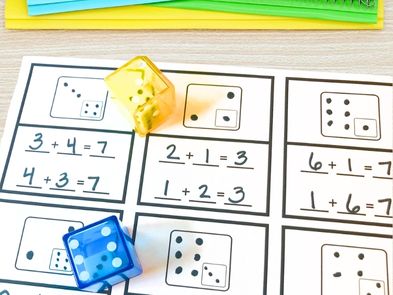
Here are three easy dice ideas:
- Dice with smaller or larger numbers (easy way to differentiate for learners!)
- Dice with numerals instead of dots.
- Dice within a dice (pictured above)
3. Ten-Frame Flip
Ten-frames are a powerful visual for this concept! Slide the ten-frame into a write and wipe pocket and you’re ready to practice! Students show an addition fact like 5+3=8 on their ten-frame using two colors of counters. Then, they flip their page around to show 3+5=8. This visual connection deepens understanding and helps bridge from concrete to abstract thinking.
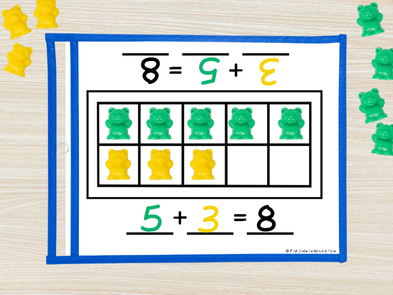
It’s easy to make this activity more game like by adding dice, a spinner, or number cards! Changing up the manipulatives also helps the activity feel fresh and new. I always love using seasonal counters!
4. Domino Flip It
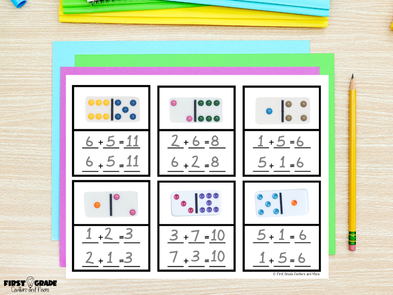
Using dominoes always feels like a game! Students choose a domino and write an addition sentence to match, Then, they flip the domino over and write the turn-around. You can use a recording sheet so they can prove both equations have the same sum. It’s simple, hands-on, and reinforces fact fluency.
5. Play Memory to Practice the Commutative Property of Addition.
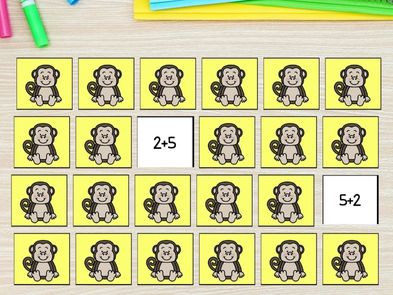
Memory is always a favorite student activity. This game is great for students who have mastered the “concrete” level of understanding and are ready to practice at a more “abstract level”. Students flip over 2 cards, identify if the two facts are a match. Increase the fact practice by having them state the sum to both cards. Then, if the cards are commutative facts, students get to keep the pair and go again! Your kids will beg to play again and again!
Ready-to-Use Games
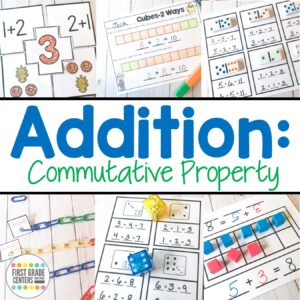
If you’d like to save prep time, my Single Digit Addition to 10: Commutative Property Games & Activities resource includes 10 different games to help your students master the concept.
It’s perfect for:
- Small group math instruction
- Partner games
- Learning Centers
- Morning Bins
- Early finishers
- Review or intervention
Each activity comes with clear directions and recording sheets — everything you need to make your commutative property of addition games both effective and easy to implement.
Need more ready to use addition games?
Why This Concept Matters
Helping students understand that 3 + 7 = 7 + 3 might seem simple, but it builds a foundation for flexible thinking in math.
They learn that:
- Numbers can move around without changing the total
- There are patterns in math
- They can use what they know to solve new problems
These ideas will support future learning in multiplication, division, and algebra. So yes — these little turn-around facts make a big difference!
Teaching the commutative property of addition through games gives first graders the chance to explore math, play with numbers, and build confidence. Next time you introduce this standard, ditch the worksheet stack and pull out some of these commutative property of addition games. Your students will be having fun and developing important math skills all at the same time!